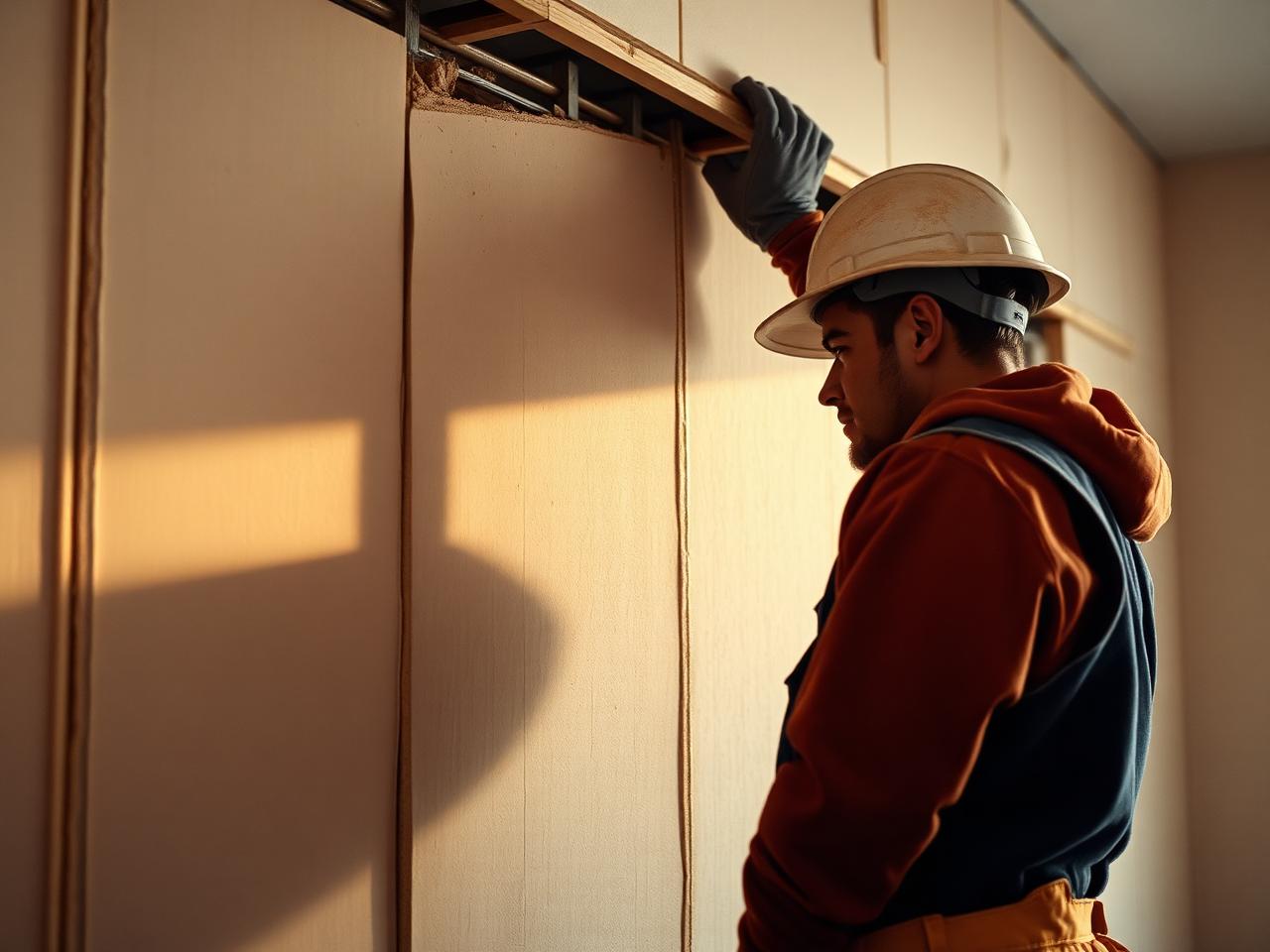
A plasterboard panel that has swollen after a leak is unlikely to be repaired reliably by painting over the stain. For plasterboard work in Hostafrancs, first establish whether water is still entering, whether the board has lost strength and what services may be concealed above a suspended ceiling. New partitions, linings, access hatches and acoustic improvements are also possible requests, but they require different specifications. The neighbourhood identifies the area of the enquiry, not the construction of any particular home. Do not drill into or dismantle a sagging ceiling without knowing what supports it.
Assessing water damage before replacing plasterboard
A ceiling stain may result from an active leak, condensation or an incident that has already been resolved. Colour alone cannot establish which. Identify the moisture source and confirm that it has stopped before deciding on a repair. Board that is soft, swollen, detached from fixings or increasingly bowed should not simply be covered with filler. The Spanish Technical Building Code's DB-HS contains provisions concerning hygiene and protection against moisture where applicable; it does not diagnose a leak in a property that has not been inspected. For a suspended ceiling, establish board type and thickness, supporting channels, hangers, spacing, perimeter details and access to concealed services. A suitable access hatch can allow future maintenance without repeatedly damaging the finish. Where water is close to lights or wiring, an appropriately qualified electrician should assess the risk before opening the ceiling. Loose panels or insecure hangers may make the area unsafe. Ordinary plasterboard should never be treated as a load-bearing support for fixtures that have not been designed into the system. If the affected area is small and the framing remains dry, sound and compatible, it may be possible to remove only the damaged section, inspect the cavity and install a matching replacement. Wider water exposure may have affected insulation, channels or fixings, making a larger repair necessary. Restoring a smooth surface is not the same as restoring the performance of the original assembly. Where a lining contained acoustic or thermal insulation, replacing the visible face alone may leave the work incomplete. For internal partitions, perimeter seals, service penetrations and connections to adjoining construction can transmit sound. DB-HR provides a technical framework for protection against noise where relevant. Adding an extra board without addressing gaps or acoustic bridges may deliver limited benefit. A new partition should be specified for its intended use, height, doors, service routes and anticipated loads. A precise decibel improvement cannot responsibly be promised without a defined assembly and appropriate assessment. Ask whether the partition or ceiling forms part of a fire-resisting or compartmentation system. DB-SI addresses fire safety requirements in applicable circumstances. Replacing a specialist board with an ordinary one, leaving an unsealed penetration or fitting an unsuitable access panel can compromise the intended performance. Product documentation and complete tested system details matter more than the appearance of an individual sheet. Finishing involves suitable screws, joint tape, compound, controlled sanding and a compatible surface treatment. The joints need to be stable before decoration. If moisture remains, even a neatly painted repair may deteriorate again. Final checks should consider flatness, perimeter junctions, accessible hatches and waste removal. Where plumbing, electrical work and decoration are involved, sequencing the trades prevents unnecessary repeated openings.
Warning signs and when a small patch is insufficient
Arrange an assessment if the ceiling bows, cracks appear around screw heads, a board feels soft or staining repeatedly returns. Take photographs from a safe position and mention lights, ducts, pipes or insulation above. A minor joint crack in a stable partition may need only surface repair; a deforming wet ceiling requires a different response. If pieces are falling or there is an electrical hazard, keep people away from the affected area and seek competent help. For a new partition, lining or ceiling, describe the room's use, approximate dimensions, service penetrations and whether acoustic performance or maintenance access matters. Heavy wall-mounted furniture may require structural reinforcement specified before the board is installed. Depending on the work, permissions or building management arrangements may also need checking.
Select the complete board and framing system
Standard plasterboard, moisture-resistant products and boards intended for specialist performance are not interchangeable merely because they look alike. Selection depends on the room, exposure and requirements of the whole assembly. Board thickness, channel spacing, fixings, perimeter strips and insulation all matter. A wall-hung cabinet may need reinforcement behind the lining rather than a different plug in the same sheet. Request the system specification and technical documentation, not just a familiar brand. Where acoustic or fire requirements apply, joints, penetrations and access panels must also be compatible.
An itemised quotation for opening, repairing and finishing
Ask for separate allowances for inspection, protecting the room, controlled removal, checking framing, replacement boards and insulation, installation, joint treatment, primer, decoration and waste disposal. Plumbing or electrical repairs should be identified as distinct work where required. Clarify how concealed damage would be authorised and whether reinstating an access hatch or particular acoustic or fire performance is included. A visible patch size does not describe all the work behind it. The name of Hostafrancs cannot establish a reliable price without the actual conditions.
