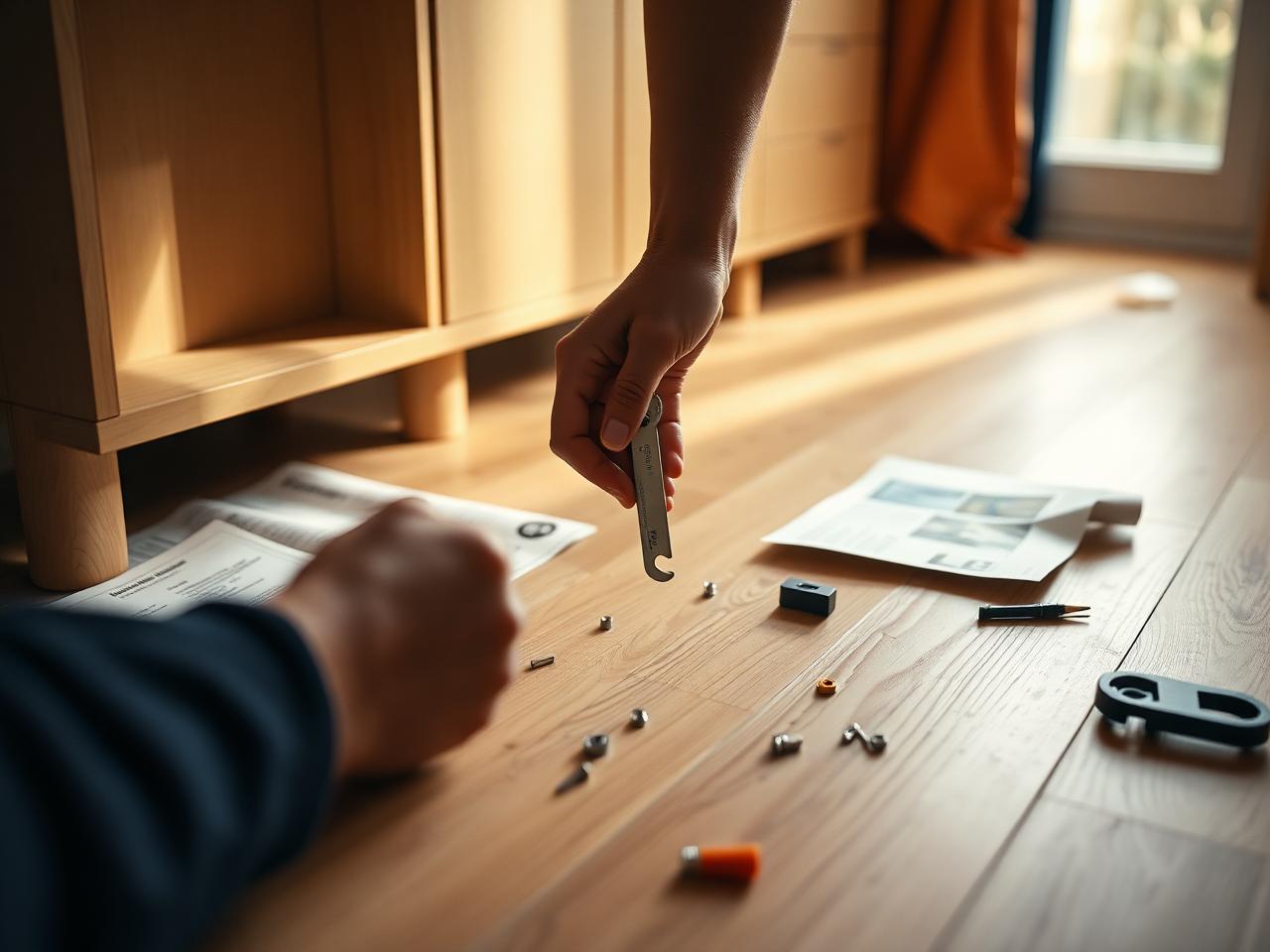
A flat-pack wardrobe that stands crooked after assembly in Hostafrancs does not necessarily have a faulty panel. The cause may be an uneven floor, a back panel fitted out of square, mixed-up connectors or doors adjusted before the cabinet body was aligned. Before taking everything apart, separate the questions of structural squareness, levelling, hinges and anti-tip restraint. Furniture assembly also includes chests of drawers, desks, shelving and kitchen units, each with different fixing needs. The neighbourhood identifies the enquiry location but does not reveal the wall material or access dimensions.
Square the wardrobe before adjusting the doors
Begin by checking the make, model, product reference, instructions and supplied components. Look for chipped panels, swollen edges, broken dowels and cam locks that no longer grip. A back panel fitted incorrectly can leave a cabinet looking complete while its frame remains out of square. Adjusting hinges in that condition may disguise the problem temporarily rather than solve it. Check the body geometry and supports first, then set door gaps, runners and handles in accordance with the manufacturer's system. Levelling should not mean forcing a cabinet against an uneven wall. If the floor varies in height, use the supports or adjustment system specified for the product where suitable. Improvised packing can move during use. Sliding doors require checks to tracks, rollers and stops; hinged doors need attention to hinge cups, adjustment screws and clearances. If a screw turns freely in damaged chipboard, fitting a larger one without assessing the joint may worsen the damage. A correct replacement fitting is preferable to combining parts from unrelated ranges. A tall wardrobe may also need suitable anti-tip restraint. Follow the product instructions and identify the actual supporting wall: brickwork, concrete and plasterboard do not call for identical fixings. The visible finish is not evidence of the wall's strength. Concealed services and permission to drill need considering before making holes. IKEA's manufacturer guidance explains why furniture restraint reduces tip-over risk, but it does not establish that the same wall plug suits every cabinet or substrate. Large panels can be awkward to lift, rotate and hold upright. The Spanish occupational safety institute INSST identifies manual-handling risks relevant to heavy and bulky components in confined spaces. Do not try to lift a fully loaded wardrobe or drag it by a door. Suspended kitchen units need especially careful support and fixing assessment because their load is not carried by the floor. The task is not complete merely because the doors close: stability, clearances and any specified restraint must also be checked.
When to repair fittings and when to replace components
Seek an assessment if doors still rub after adjustment, the cabinet rocks, restraint fittings are missing, panels are cracked or a sliding door repeatedly leaves its track. A chipboard joint that has lost strength may need a replacement side or manufacturer-specific connector; extra tightening is not necessarily safe. Avoid handling unstable furniture with glass, mirrors or heavy contents. If a wall-mounted unit appears to be coming loose, clear the area and avoid adding weight until the support has been checked.
Matching hinges, connectors and wall fixings
Record the dimensions and references of hinges, runners, cams and shelf supports. A fitting from another brand may look similar without being compatible. Chipboard, MDF and solid wood respond differently to screws and moisture. Wall anchors must suit the product, load and supporting material. Replacing a door involves hinge-hole positions and weight as well as its finish. The original assembly manual remains the starting point even when the furniture seems straightforward.
An itemised furniture assembly quotation
Provide the number of packages, product reference, dimensions, condition of parts and whether an old unit must be dismantled. Ask for separate allowances for unpacking, sorting, assembly, levelling, door adjustment, wall restraint, packaging removal and replacement components. The Catalan Consumer Agency recommends written quotations and advance communication of new cost items. A photograph of the wardrobe cannot establish wall strength or the route for carrying panels inside. These unknowns should be made clear before a fixed scope is agreed.
