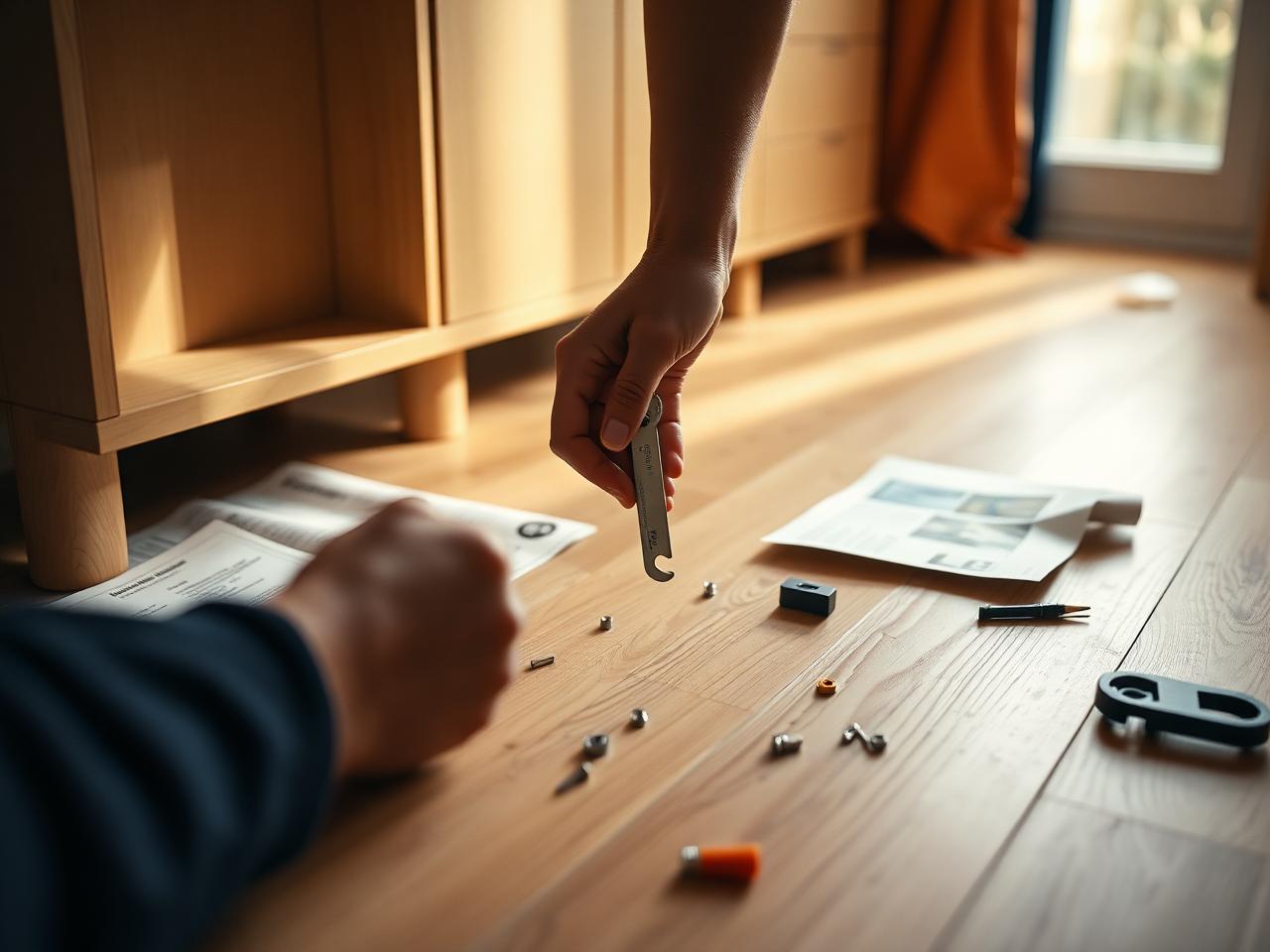
A flat-pack wardrobe with misaligned doors in el Besòs i el Maresme does not necessarily need new hinges. The base may be uneven, the cabinet frame may be out of square, sliding tracks may be misplaced or hardware may have been tightened before the panels were aligned. Adjusting a door without checking the whole assembly can conceal the cause and strain particleboard fixings. Before requesting furniture assembly, record the wardrobe model, dimensions, whether the doors slide or swing, and where they catch. Do not force a heavy door or attempt to hold an unstable wardrobe on your own. A useful repair begins with the cabinet's stability, not with random hinge adjustments.
Check the cabinet frame before adjusting door hardware
Start with the manufacturer's assembly instructions and an inventory of panels, screws, cam locks, hinges, tracks and stops. Check that the base stands firmly, the side panels are vertical and the cabinet is square. A slight twist can make the doors overlap badly even when their hinges are sound. Hinged doors require adjustment of position, depth and clearance; sliding doors rely on runners, rollers, height settings and end stops. Tightening screws harder in particleboard is not a safe way to correct a distorted cabinet. If a fixing hole has stripped, a compatible repair or replacement panel may be needed instead of an oversized screw. The back panel and structural shelves must be fitted as the design requires before the doors are loaded. Heavy mirrored panels need suitable handling assistance to avoid breakage and injury. Final adjustment should take place in the wardrobe's intended position, because moving it to a different floor surface may alter its alignment.
Keep heavy panels and unstable cabinets away from children
If the wardrobe leans, a mirror door is loose or the cabinet creaks under light movement, stop loading it. Keep children away and do not try to lift it alone. Temporary shelves should not be used to carry weight while structural pieces are missing. The neighbourhood identifies the enquiry area, not the wall composition or floor condition in a particular home. Send photographs of the model label, full wardrobe, door hardware and point of contact, without dismantling anything that may fall. A decision to adjust a hinge, replace a runner or rebuild part of the cabinet should follow inspection of the real parts and their condition. This avoids paying for replacement hardware that cannot correct a distorted frame.
Use model-specific fittings and check anti-tip anchoring
Hinges and sliding tracks are not interchangeable simply because they look similar. Hole spacing, cup diameter, runner travel and permitted load matter. A tall wardrobe should follow the manufacturer's anti-tip instructions, with wall fixings chosen for the actual substrate. A plug designed for solid masonry may not hold in a hollow partition; drilling also requires checking for concealed services. Levelling feet and packers, where specified, must provide stable support rather than leaving the unit balanced on an improvised point. An uneven floor is not a reason to cut panels without a design assessment. Keep product labels and part numbers so that correct hinges, rollers or cover pieces can be ordered. If a door collides with a wall or obstructs circulation, the wardrobe's position may need reviewing rather than forcing the hardware into an unsuitable setting.
Separate assembly, alignment, wall fixing and replacement parts
Request a written scope covering parts inventory, cabinet assembly, levelling, door installation, track or hinge adjustment, anti-tip fixing and final checks. Clarify whether packaging removal, movement of the assembled wardrobe and disposal of damaged parts are included. If a component is missing or a panel arrives damaged, the proposal should explain whether assembly must wait for a replacement. Labour depends on the model, size, access, number of doors and condition of the kit; a fixed completion time cannot be assumed from the neighbourhood alone. State who supplies any new parts. If the wall construction is unknown, make anchoring subject to inspection and approval before extra work. Final checks should cover full opening and closing, even door gaps, correctly seated shelves, accessible fittings and absence of rocking. A wardrobe with neatly aligned doors but an unresolved tipping risk is not finished safely.
For furniture assembly in el Besòs i el Maresme, provide the model, dimensions, door type and whether the wardrobe is stable. Ask for frame alignment, hardware and anti-tip fixing to be assessed before replacement parts are ordered.
