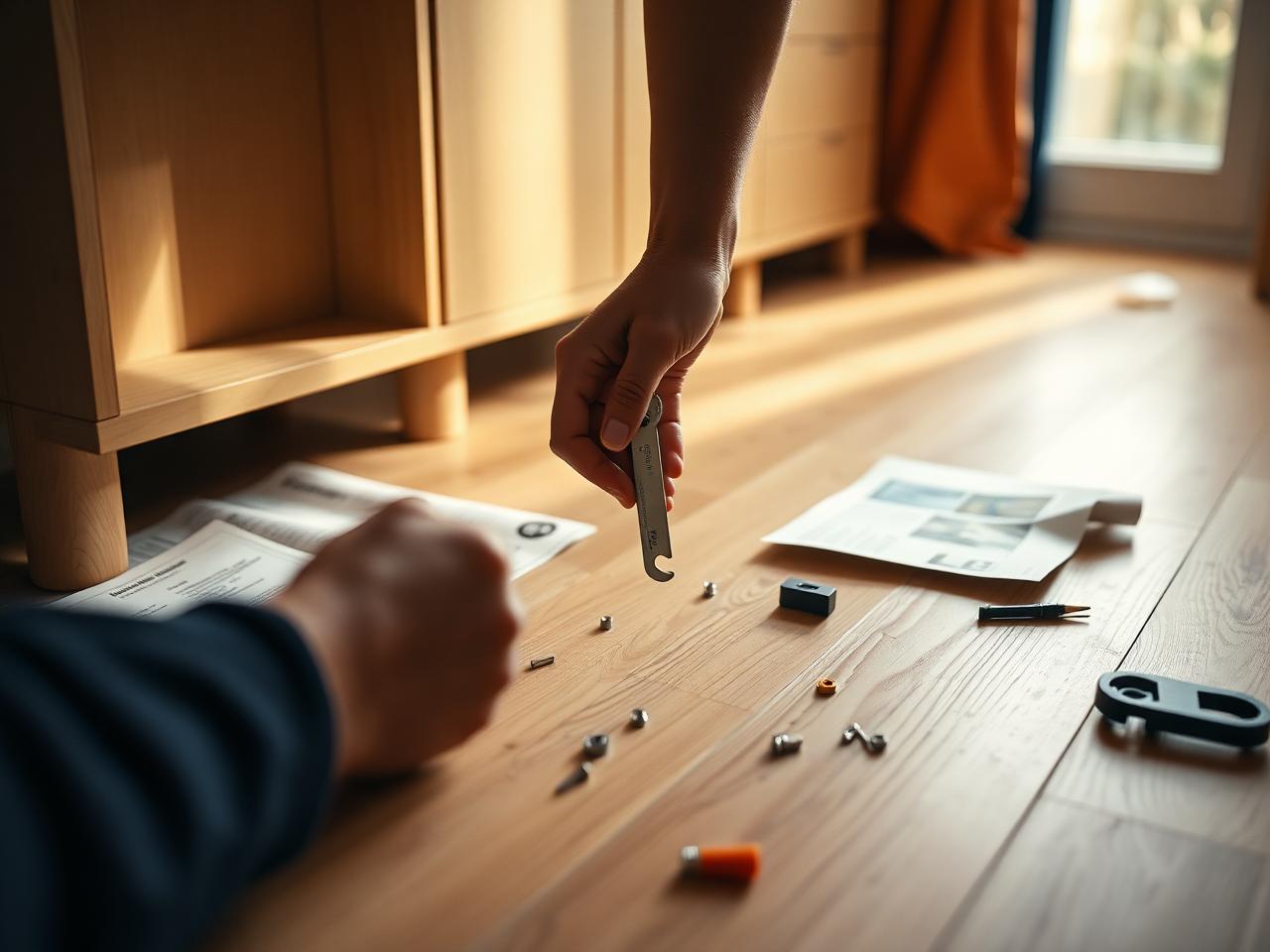
A fold-down desk that dips under a modest load, a chest of drawers that tips forwards when opened and a modular shelving unit that will not sit square are different furniture assembly problems in La Trinitat Nova. The order of assembly, the condition of connectors, the stability of the finished unit and the actual wall substrate all matter. This guide helps you describe requests involving wardrobes, beds, desks, kitchen units and storage furniture, whether the task is assembly, adjustment, repair or dismantling. It makes no assumptions about the buildings, walls or access arrangements in the neighbourhood.
Check the assembly system before tightening anything
A folding desk is not supported in the same way as a free-standing table. Identify its hinges, support arms, locking action and the manufacturer's stated load before fixing the top. Look for pinch points during opening and closing. A bracket that feels solid in your hand may not be designed for repeated leverage once attached to a wall. If instructions are missing, photograph labels and fittings before buying substitutes. Never assume that a fold-down surface can safely take a person's weight. A tall chest of drawers may become unstable when several drawers are opened. Start with its base, feet, runners, back panel and the joints between the sides. Being level does not by itself make the unit resistant to tipping. Where the manufacturer specifies an anti-tip restraint, that requirement should not be treated as optional decoration. The fixing must suit the identified substrate and expected load. Plasterboard, hollow masonry and solid masonry do not automatically accept the same plugs. Check for concealed services before drilling and stop if the substrate is uncertain. For modular shelves, sort the panels, shelves, dowels, bolts and cam locks by the manual rather than by appearance alone. If the frame is out of square, compare its diagonals and check the back panel before forcing the next shelf into place. A cam lock that spins without gripping may be misaligned, damaged or fitted into a weakened hole. Replacing it with a larger screw can tear out more of the board. Decide whether a connector can be replaced only after checking that the surrounding material will still hold it securely. Sliding wardrobe doors need their own checks. Inspect tracks, end stops, rollers and alignment before altering height adjusters. Do not try to support a heavy mirrored panel on your own. With hinged doors, repeated adjustment may hide a cabinet carcass that has gone out of square. If the underlying shape is not corrected, new rubbing points can appear elsewhere. The choice between adjustment, replacement fittings and a new panel depends on dimensions, damage and the load carried by each joint. When dismantling a bed or desk for a move, label the groups of fasteners and protect exposed edges. Some flat-pack boards are not intended for repeated assembly because their screw holes lose grip. Before committing to reassembly, check whether the maker permits it, whether any connectors are missing and whether joints carry movement or changing loads. A completed job should be assessed for stability and safe operation, not merely for whether every panel has been fitted.
When to stop and request a separate assessment
Stop using a chest that is close to tipping, a shelf pulling away from its fixings or a folding desk with moving anchors. Keep children away from unstable furniture and do not attempt to hold a loaded unit upright by hand. If drilling reveals wiring, pipework or active damp, stop and involve the appropriate trade. Concealing a defect behind a cabinet is not a repair. Furniture near a fire-protected door, a shared passage or an escape route may require a different assessment and permission. In rented accommodation, check who can authorise permanent drilling. Photographs and measurements are useful for planning but cannot prove that a fixing is safe. Do not exceed a manufacturer's load guidance on the basis of how sturdy a unit appears.
Match fittings to the board and the wall
Solid timber, chipboard, laminated panels and metal frames react differently to tightening, moisture and repeated use. A brand name alone does not identify a replacement fitting. Record board thickness, hole diameter, screw length, connector geometry and its purpose. If an edge has swollen, establish whether the core has lost strength. A new hinge cannot repair a crumbling support. Manufacturer instructions remain important for assembly order, permitted loads and safety devices. Where a unit requires restraint, the wall becomes part of the system. Its material, condition and the spacing of fixings must be considered. The Spanish Building Technical Code's DB-SUA covers aspects of safe use, while DB-SI may matter where a fitting could interfere with an escape route. Neither document makes an unidentified wall safe to drill. A competent assessment may be necessary before installing a heavily loaded or suspended unit.
Ask for an itemised quotation for the actual scope
List each item, its model or instructions, approximate dimensions and whether it is boxed, partly assembled or previously used. Separate first-time assembly from door adjustment, connector repair and dismantling for transport. Say whether wall restraints, floor protection, packaging removal or movement of bulky boxes are needed. These are different tasks and should not be hidden inside a vague flat-rate description. A useful quotation separates labour, travel where applicable, connectors, wall fixings, consumables, replacement parts and waste handling. Ask what happens if components are missing, if the wall will not accept the proposed fixing or if damage changes the scope. Additional work should be priced and approved before it begins. No unverified price, attendance time or availability is promised here. The Catalan Consumer Agency publishes guidance on documentation and rights for repairs and home services.
