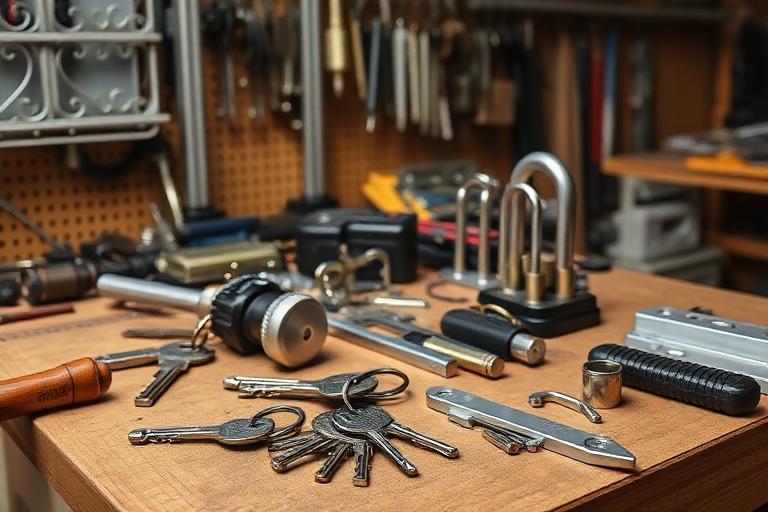
A jammed lock in Sant Pere, Santa Caterina i la Ribera is not the same problem as a dropped door or a shared entrance that fails to latch. Barcelona City Council places this neighbourhood in Ciutat Vella, but its location does not prove that any particular building is historic, protected or served by an available locksmith. Explain whether the key turns, whether the handle retracts the latch, whether the fault occurs with the door open and whether the entrance is private or communal. If keys are lost, be prepared to establish your right to access the premises. Avoid forcing the cylinder or agreeing to drilling before the likely mechanism has been assessed.
Diagnose the lock and door alignment before drilling
First distinguish a door pulled shut on its latch from one locked with full turns of the key. The latch may be the obstacle in the first case, while the cylinder, lock case and bolts are involved in the second. If the mechanism works with the door open but jams when closed, check whether the door leaf, hinges, frame or strike plates are misaligned. A key turning without moving the bolt can indicate a transmission problem rather than a failed cylinder. A handle that does not spring back may point towards the furniture or internal lock case. Do not insert improvised tools or keep twisting a bending key. Ask what non-destructive opening options are realistic, what damage each method risks and which component is actually proposed for replacement. Safe photographs of the external furniture and door edge may help initial identification, but they cannot reveal the condition of every internal part. A precise diagnosis avoids paying for a complete new lock when alignment or another smaller component is responsible.
Proof of access, shared entrances and safe escape
Anyone requesting entry to private premises should be able to demonstrate authorisation. Ask how the provider will verify it and protect personal information. For a shared building entrance, changes to cylinders, keys, door closers or access controls affect other residents and require the appropriate community decision. A door that slams may need its closer adjusted rather than its lock replaced. Where an entrance forms part of an escape route, applicable fire-safety and accessibility requirements must be considered alongside security. The Building Technical Code addresses certain door and evacuation arrangements, but it does not automatically approve a product for every building. If you suspect forced entry, prioritise personal safety and avoid disturbing potential evidence. Do not circulate images showing identifiable key profiles or access codes. If the lock serves a commercial or publicly used entrance, make its use and expected footfall clear before requesting hardware recommendations.
Match the cylinder, escutcheon and multipoint mechanism
Before selecting a cylinder, establish its length, fixing arrangement, position relative to the protective escutcheon and compatibility with the lock case. A cylinder projecting too far can be exposed, while the wrong length can make fitting impractical. A poorly aligned escutcheon may rub against the key and resemble an internal cylinder failure. Multipoint doors require the full travel of their bolts and each receiving plate to be checked. In communal buildings, the handling of replacement keys and authorised copies also needs agreement. One advertised security feature cannot guarantee the resistance of the whole door assembly, which includes the leaf, frame, fixings and furniture. Ask for identifiable part references, the number of keys included and any operating instructions. For doors used by the public or on escape routes, convenient and safe exit can limit which locking arrangements are suitable. Choosing hardware requires understanding the whole entrance, not simply a product photograph.
Written pricing, supplements and a documented handover
The Catalan Consumer Agency recommends obtaining a written quotation and checking the identity of a home-service provider. Request separate details for diagnosis, any call-out, opening work, labour, replacement parts, taxes and legally applicable supplements. Ask beforehand whether preparing an unaccepted quotation would be charged. Non-destructive entry and entry requiring a new cylinder have different scopes. If a further fault is discovered, ask for an explanation and agreement to any price variation before work continues. Consumer guidance distinguishes the circumstances for night and public-holiday supplements; a neighbourhood page must not be read as a promise of an emergency rate or arrival time. At completion, check safe operation from both sides, handle return, key count and the continued usability of necessary exits. Keep the accepted quotation, itemised invoice, warranty details and part references. This information is intended to support a sensible enquiry, not to claim that a previous locksmith visit took place on a particular street.
Describe the lock fault in Sant Pere, Santa Caterina i la Ribera to request a written diagnosis and quotation without assuming an immediate appointment.
