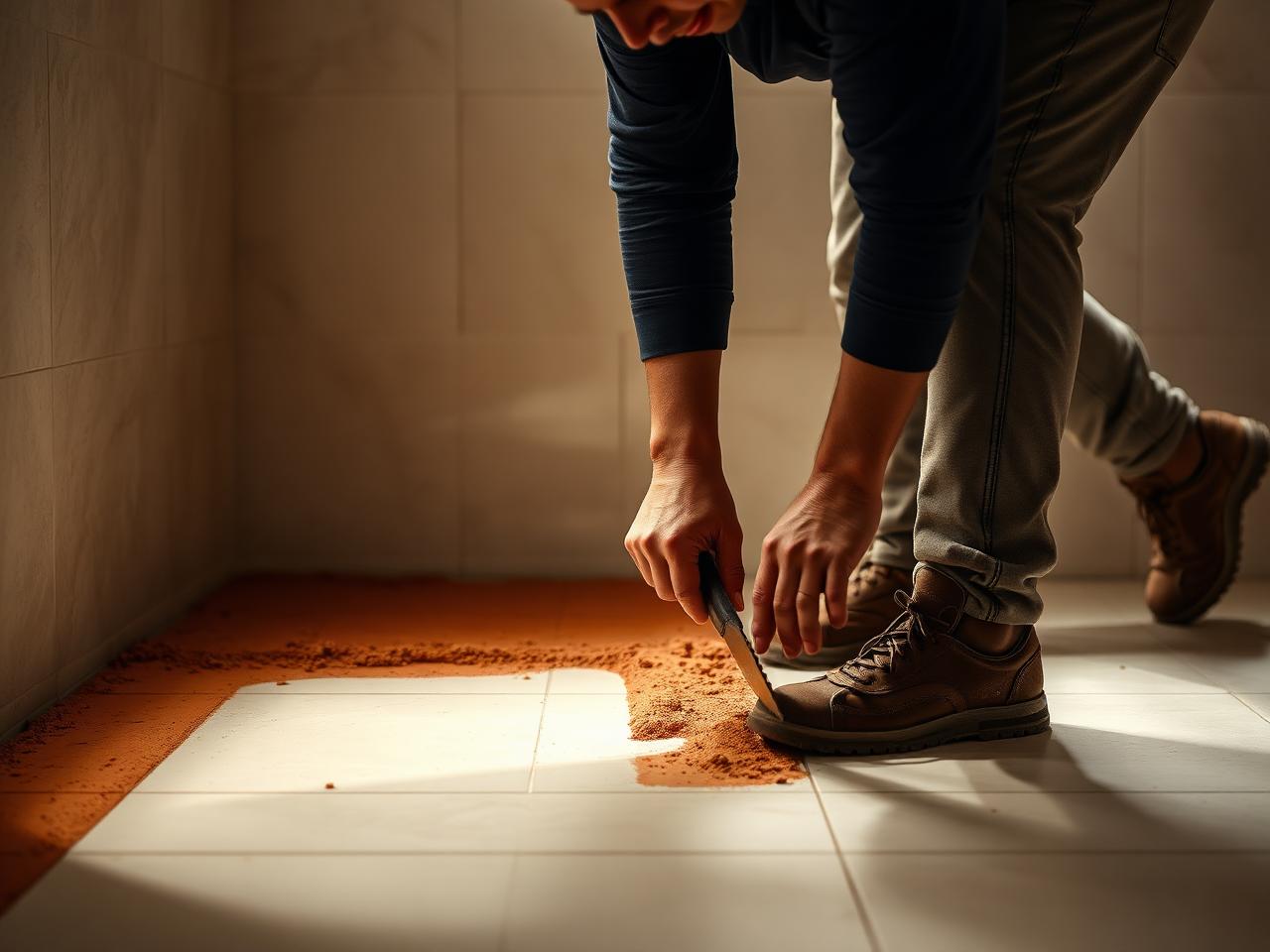
A loose tile at a doorway threshold in Pedralbes might be a small finishing defect or a sign of movement, damp or failed adhesion underneath. Before sticking it down again, check whether it creates a trip hazard, whether the joint has opened and whether nearby tiles are affected. General masonry repairs also cover damaged finishes, small areas of render, pointing and edge details, but a surface repair should not conceal a problem with its supporting base. The neighbourhood identifies where the enquiry relates to; it does not establish how any particular building was constructed.
Assessing a threshold and repairing the underlying cause
Start by identifying the affected area without lifting more tiles than necessary. A hollow sound can indicate poor contact or adhesion, but it does not by itself prove structural movement. Look for cracked edges, loose grout, water staining and a difference in floor level. If there are sharp fragments or an obvious trip hazard, keep the passage safe until the repair can be assessed. Photographs of the whole doorway and the damaged detail are more useful than a close-up with no scale. There are several possible repair paths. An intact tile on a sound, dry base may be reusable after defective adhesive has been removed and the surface properly prepared. A broken or chipped piece may need replacement. If the original range is no longer available, an exact match in shade, size or texture cannot be promised. Several cracked tiles, recurring joint movement or persistent damp call for a broader investigation; simply applying stronger adhesive may hide the cause for a short time rather than solving it. A junction between different floor finishes can require a transition strip, movement joint or carefully levelled edge. The correct detail depends on the substrate, traffic and the actual change in height. Packing a large gap with excess adhesive is not a reliable way to compensate for a poorly prepared base. Select mortar and adhesive from the product's stated uses, not from a familiar brand name alone. Allow for the manufacturer's curing requirements before the threshold is returned to normal use; a dry-looking surface is not necessarily ready for repeated foot traffic. The same diagnostic approach applies to other modest masonry tasks: repairing render, renewing grout, replacing individual cladding pieces and finishing small openings. It is important to distinguish a cosmetic crack from one associated with movement. The Spanish building code's DB-SUA guidance is relevant to safe use and floor surfaces where applicable, while DB-SE provides the wider structural framework. Neither source proves the condition of an unseen substrate in a particular Pedralbes property.
When to arrange an assessment rather than a quick patch
Ask for an assessment if a tile rocks underfoot, the height difference is noticeable, sharp edges are exposed or the same joint keeps opening. If water is present, investigate its origin before covering the area with mortar. Widespread cracking, deformation or a risk of heavy material falling calls for a competent specialist rather than a DIY trial. Clarify whether the threshold is inside a private home, at a shared entrance or exposed outdoors; access, permission and use conditions matter more than assumptions about the neighbourhood.
Matching tiles, adhesives and transition details
The existing finish might be ceramic, stone, terrazzo or another product. Record its dimensions, thickness, condition and likely compatibility with the base. Not every adhesive suits a damp or flexible substrate. A metal transition profile may be appropriate where a joint or level change needs protection, but it should not be used to disguise movement. Follow manufacturers' technical sheets and check whether a replacement can be sourced. If moisture is suspected, the CTE DB-HS provides general health and moisture-control context; identifying the actual water path remains a separate task.
What an itemised masonry quotation should contain
A useful quotation distinguishes inspection, area protection, removal, cleaning, substrate preparation, replacement materials, laying, grouting, edge finishing and waste handling. It should say whether existing pieces can be reused and how unexpected damage would be priced and authorised before extra work begins. A postcode is not enough to give a reliable fixed price. Provide approximate measurements, photos, the number of affected tiles and any history of damp or repeated movement. Where shared building elements are involved, clarify ownership and approval requirements before work is agreed.
